About TTW
The Transition to Work Program supports learners with disabilities and recent graduates in building the confidence, skills, and connections needed for career success. Through workshops, events, and networking opportunities, participants can develop career readiness skills, explore employment pathways, and connect with employers, alumni, community agencies, and Humber support services. The program also provides guidance on self-advocacy, workplace accommodations, and ongoing personalized support throughout each learner's career journey.
Upcoming Events and Parnterships
Oct.6
TTW Career Webinar & Networking Opportunity
11:00 AM - 12:30 PM | Virtual and In-Person (LRC 3rd floor)
Interested in building a career in government?
This informative career webinar featuring speakers with experience in provincial and federal government recruitment.
Learn about student employment, internships, graduate opportunities, and programs specifically designed to support people with disabilities.
Oct.8
Coffee Chat with Industry
12:00 - 2:00 PM | In-Person, Lakeshore Campus
oin us for an engaging coffee chat featuring representatives from the Toronto Foundation, Magnet, and the Newcomer Centre of Peel. Students will gain insight into the impactful work these organizations do in community development, employment support, and newcomer services, while learning about diverse career pathways in the non-profit and social impact sectors.
This is a great opportunity to ask questions, explore roles in community-focused work, and connect with professionals dedicated to creating meaningful change.
Oct.14
Coffee Chat with Industry
1:30 - 2:30 PM | In-Person, North Campus
Join us for an engaging conversation with Alexandria Fisher as she shares her personal and professional journey, including being diagnosed later in life and navigating her career with a disability. Alexandria will discuss how she has built a successful career spanning finance, environmental sustainability, and leadership, while offering insights, advice, and inspiration for students entering the workforce.
If you are a student who identifies with having a disability OR have a passion for sustainability, this one is for you!
Parntership
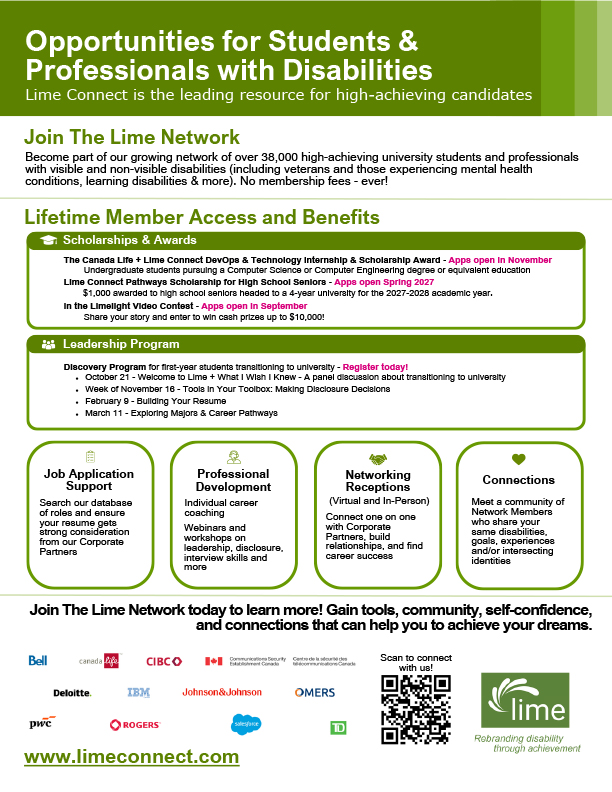
Join The Lime Network
Opportunities for Students & Professionals with Disabilities
Become part of our growing network of over 38,000 high-achieving university students and professionals with visible and non-visible disabilities (including veterans and those experiencing mental health conditions, learning disabilities & more). No membership fees - ever!
Career Coaching for Students and Recent Graduates with Disabilities
Current Humber Polytechnic students and recent graduates (up to two years after graduation) with disabilities can access targeted career coaching to support their transition from education to employment.
Meet with a Student Success Advisor (SSA) to learn how to:
- Explore career and educational pathways that build on your strengths, address challenges, and support your goals.
- Clarify and articulate disability-related strengths and advantages in workplace settings.
- Access the Disability Impact on Career and Employment (DICE) assessment to better understand how disability may influence career and employment success.
- Develop self-advocacy skills for accommodation conversations in WIL field experiences and employment settings.
- Build advanced disability-informed career, job search, and employment strategies beyond foundational job search support.
- Strengthen your confidence as you transition from education to employment.
This advising experience was very informative. It was beneficial that I was informed about a crucial mistake I made on my resume, explaining why I hadn't been able to find a job. I'd strongly recommend that other students at Humber take advantage of career services at Humber, especially this one.

Elaine Belanger-Porter
Student Success Advisor
Students In and From Care / Career Support for Students with
Disabilities
(437) 565-1398 | elaine.belanger-porter@humber.ca | Booking link
Accessible Learning Services (ALS) and the Student Success Advisor (SSA): Working together to support student success.
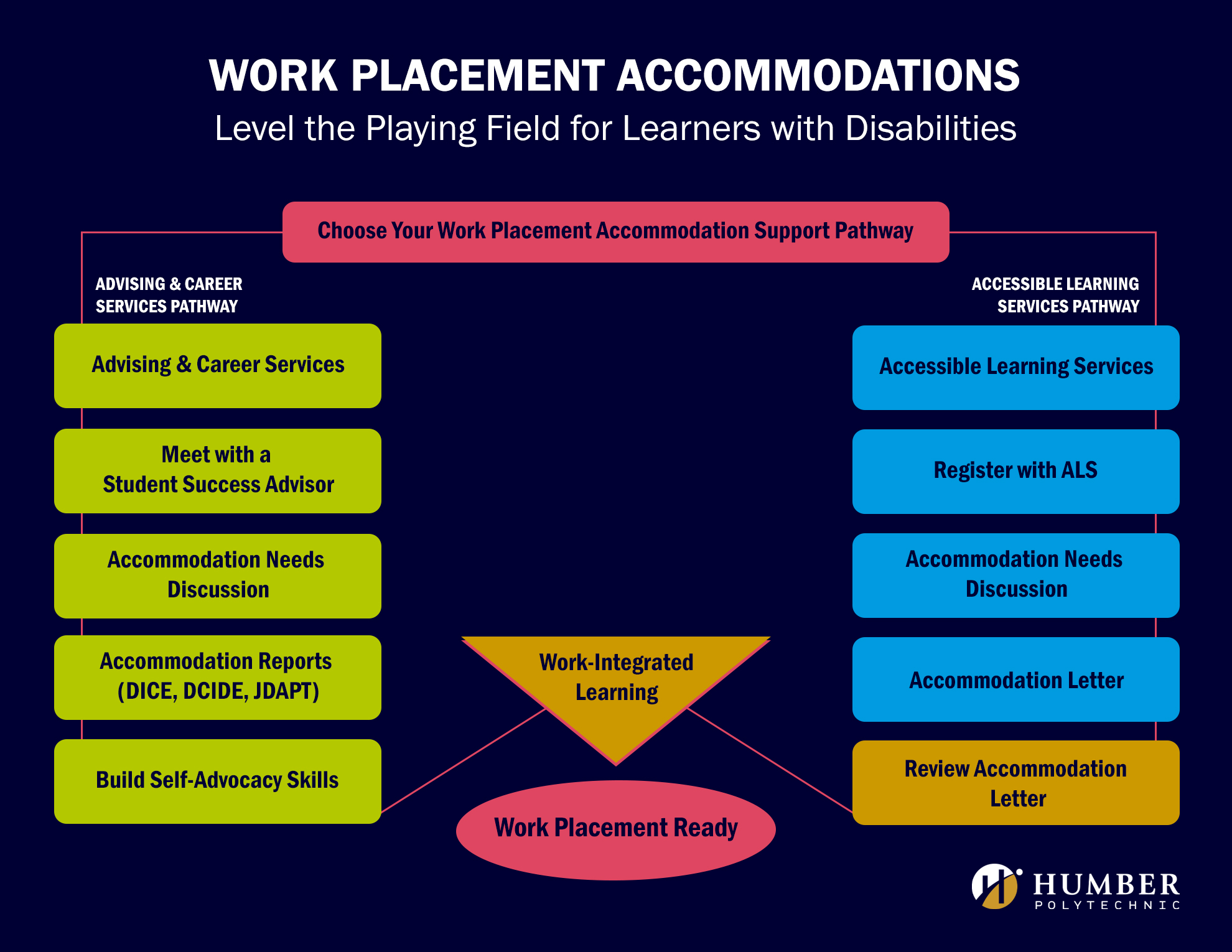
- Accessible Learning Services (ALS) focuses on academic accommodations and accommodation documentation, including official accommodation letters for academic and Work-Integrated Learning (WIL) field experiences.
- The Student Success Advisor (SSA) supports students and recent graduates with disabilities through disability-informed career planning, self-advocacy development, disability and employment assessments, and preparation for accommodation conversations in Work-Integrated Learning (WIL) and employment settings.
Looking for a Different Service?
Work-Integrated Learning (Field Experience or Clinical) Accommodations
If you require disability-related accommodations for a Work-Integrated Learning (WIL) experience, including a practicum, clinical, or field experience, please connect with ALS, which reviews accommodation needs and issues official accommodation letters for WIL experiences.
- Current Humber learners registered with ALS - Visit the ALS Portal
- UGH and Humber learners who have not previously worked with ALS - Email accessible-learning@humber.ca.
Foundational Job Search Support
If you are looking for assistance with resumes, cover letters, interview preparation, and job search fundamentals, start with Humber Career Services
Self-Advocacy Learning (SAL)
Self-Advocacy Learning (SAL) helps you build the communication skills, self-awareness, and confidence to discuss your strengths, challenges, support needs, and goals in school, the workplace, and your career.
SAL encourages you to view self-advocacy not only as an employability skill, but as a mindset. In a labour market that is not always designed with disability and diverse learning needs in mind, self-advocacy can help you recognize your value, navigate barriers, and access the supports and opportunities that help you thrive.
SAL includes two learning resources:
- SAL Toolkit - practical tools and personalized statements to help you communicate your strengths, accommodation needs, and value to employers.
- SAL Micro-Training - short online modules that help you build self-awareness, confidence, and self-advocacy skills.
Through SAL, you will learn how to identify and communicate your strengths, address challenges and barriers, advocate for your needs, and confidently navigate school and workplace environments.
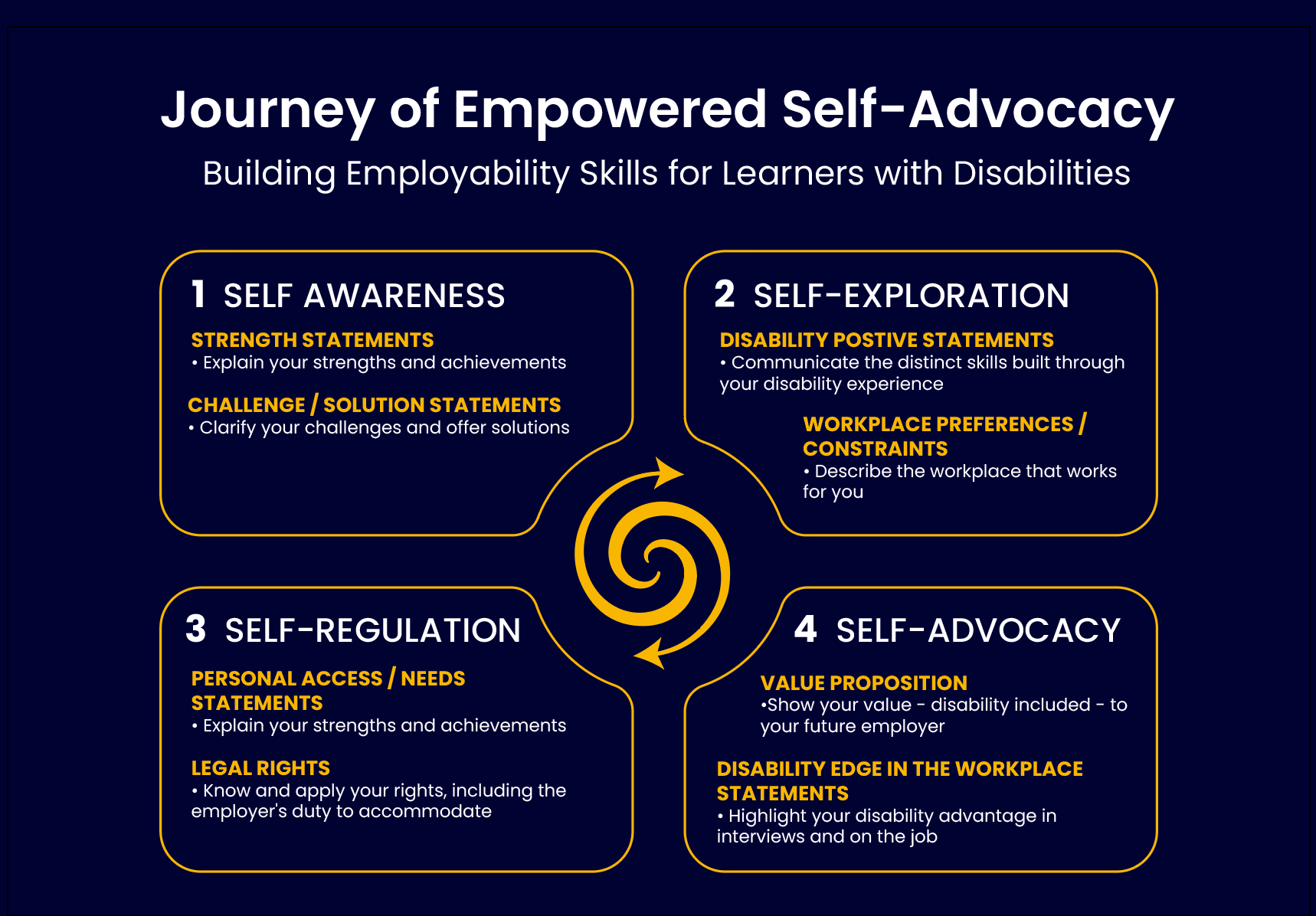
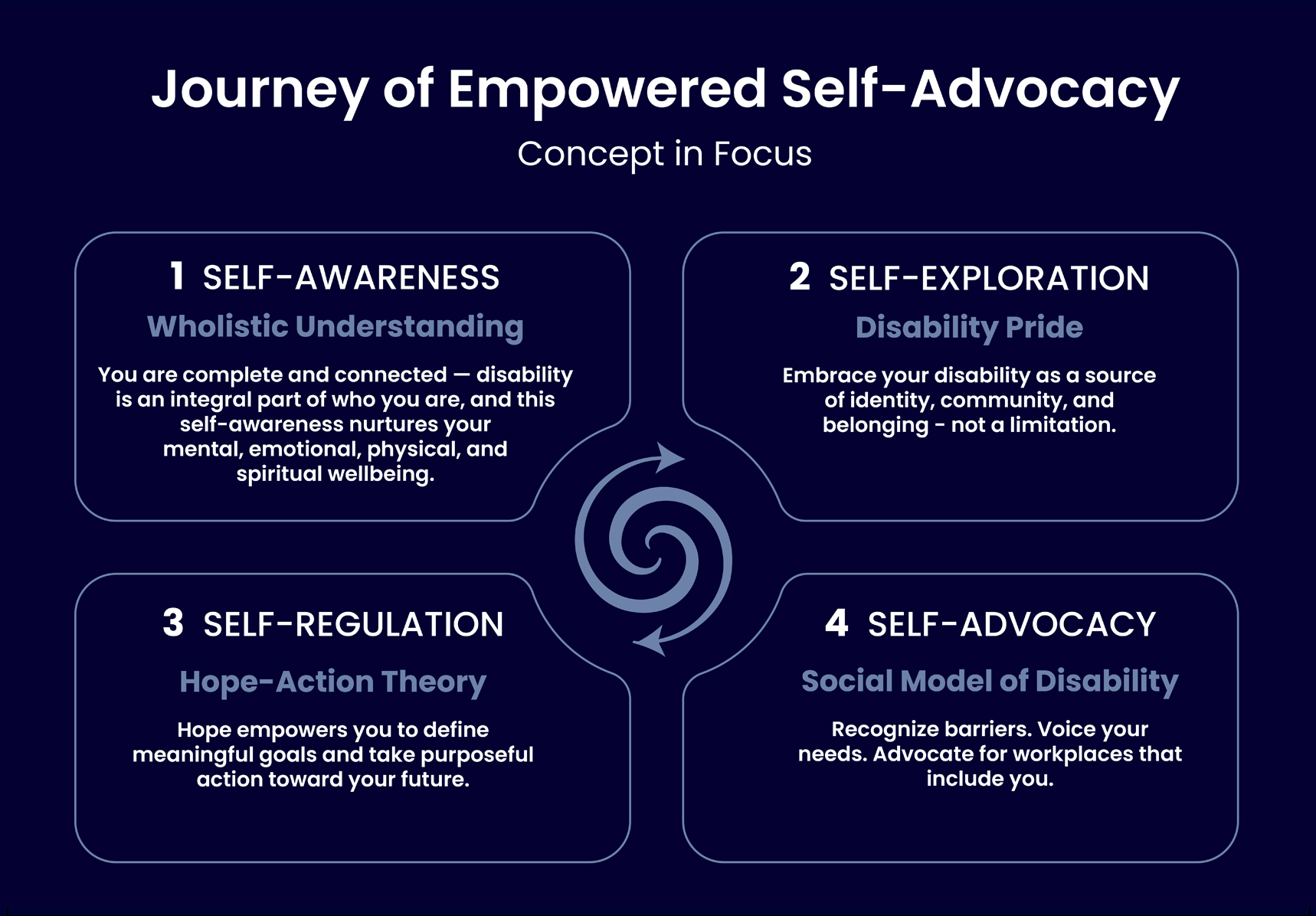
The SAL framework is built on four interconnected areas of self-advocacy development.
SAL Toolkit
The SAL Toolkit helps you create personalized self-advocacy statements based on your strengths, experiences, goals, and support needs.
- Build a toolkit using seven strategic statements that help you communicate your strengths, accommodation needs, and value to employers.
- Practice clear language for interviews, networking, workplace conversations, and classroom discussions.
- Customize your toolkit as your goals, experiences, and confidence grow.
- Apply by accessing the SAL Toolkit on our Career Resources page.
SAL Micro-Training
The SAL Micro-Training helps you develop the mindset, knowledge, and self-advocacy skills needed to succeed in school, work, and your career.
- Learn self-advocacy concepts, strategies, and tools that support success in school, work, and your career.
- Explore self-advocacy as a mindset by challenging limiting beliefs and developing a more empowered understanding of your abilities, potential, and value.
- Reflect on concepts that deepen self-awareness, help you recognize both strengths and challenges, build hope for the future, identify pathways to your goals, and address barriers in school and work.
- Reframe challenges and self-limiting beliefs into opportunities for growth while creating and strengthening your SAL Toolkit statements.
Access Self-Advocacy Learning (SAL) Micro-Training
The Self-Advocacy Learning (SAL) Micro-Training is available to current students, staff, faculty, and recent graduates. Complete the form below to request access to the micro-training.
The training links will be sent to the email address you provide. Your name and email address are required so that we can process your request and send you access to the training.
About TTW
The Transition to Work Program aims to enhance successful career outcomes and strategies for persons with disabilities through hosting workshops and events, and connecting learners with college support staff, employers, alumni and community agencies.
The Transition to Work Program for people with disabilities aims to:
- promote self-advocacy
- provide opportunities to develop career readiness and exploratory skills
- offer career preparedness workshops and events
- offer tips for disclosing and negotiating accommodation needs in the workplace
- offer regular wraparound supports as part of learner's career readiness journey
- share examples of successful workplace accommodations and supportive employers
Job Search Prep (Current Students)
Successful job searching starts with understanding your strengths and challenges, preparing your application materials, and then actively searching for opportunities. Follow the steps below to build confidence and prepare for employment success.
Before you start your job search, take time to understand your strengths, challenges, support needs, and career goals. Self-assessment can help you make informed decisions about career options, workplace supports, accommodations, and employment strategies.
The The Disability Impact on Career & Employment (DICE) Assessment
The Disability Impact on Career & Employment (DICE) assessment can help you:
- Identify disability-related strengths, challenges, and transferable skills that may influence workplace success.
- Explore careers and work environments that align with your interests, strengths, support needs, and preferred ways of working.
- Recognize potential barriers in employment and identify strategies to address them.
- Determine workplace accommodations and supports that may contribute to job success.
- Build confidence in discussing strengths, challenges, and accommodation needs in employment settings.
Contact Elaine, Student Success Advisor, to learn more about the DICE assessment and determine whether it may be helpful for your career planning and employment goals.
Email: elaine.belanger-porter@humber.ca
Additional Free Self-Assessments Available 24/7
DCIDE (Decision-Support for Communicating about Invisible Disabilities that are Episodic).
DCIDE helps learners and workers decide whether, when, and how to share disability- or health-related information in workplace settings. Complete the questionnaire online and save your results for future reference and discussion.
JDAPT (The Job Demands and Accommodation Planning Tool).
JDAPT helps learners and workers with disabilities identify workplace accommodation ideas and practical support strategies related to specific job demands. When completing the assessment, imagine yourself in a workplace setting so the results reflect your employment-related needs. Complete the questionnaire online and save your results.
Contact Elaine Belanger-Porter, Student Success Advisor, to review the results of any of these assessments and discuss how the information can support career planning, self-advocacy, accommodation conversations, and employment success. Email: elaine.belanger-porter@humber.ca
Build Your Resume, Cover Letter, and LinkedIn Profile
Most employers request a resume as part of the application process, and many use LinkedIn to learn more about candidates. Career Support Peers (CSPs) can help you create or improve your resume, cover letter, and LinkedIn profile through in-person or virtual appointments. Book an appointment to get started.
Interview Preparation
Interviews can feel stressful, but preparation can increase your confidence. Meet with a Career Support Peer to practice interview questions and participate in a mock interview.
If you require accommodations for an interview, make your request when you receive the interview invitation. Learn more in Talking About Accommodations.
For more detailed tips and resources, read through our Job Interview Tips".
EXPAND Your Job Search Skills - Career Student & Success Advisor
Meet with a Career & Student Success Advisor to learn more about networking, employment research, job search strategies, labour market trends, and career planning. Book a one-on-one appointment with a program specific Career & Student Success Advisor.
ADVANCE Your Job Search - Student Success Advisor
After developing foundational job search skills, connect with the Student Success Advisor for targeted disability-informed career and employment coaching.
Receive support with:
- Advanced resume and cover letter customization tailored for a specific job posting.
- Interview preparation and response development.
- Self-advocacy strategies for employment and Work-Integrated Learning.
- Disability-informed job search and employment planning.
Use Humber's CareerConnect Job Portal to search and apply for full-time, part-time, internship, summer, volunteer, and Work-Integrated Learning opportunities. You can also connect with employers and access career-related events and resources.
Once you begin applying for opportunities, it is important to continue developing self-advocacy skills and understanding workplace accommodations.
Finding a job is only one part of the employment journey. Long-term employment success often involves understanding your accommodation needs, communicating effectively, and advocating for yourself in workplace settings. Explore the following resources to strengthen your self-advocacy skills and prepare for workplace success.
- Talking About Accommodations
- Self-Advocacy Learning (SAL)
Job Search Strategies (Graduates)
Job Search Strategies for Recent Graduates
Continue your employment journey with support from Transition to Work, Career Advancement Services (CAS), and community employment resources.
Student Success Advisor
As a recent graduate, you can continue to access Transition to Work services for up to two years after graduation. Meet with the Student Success Advisor for disability-informed employment support, including:
- Career planning and employment strategy.
- Self-advocacy and accommodation planning.
- Advanced resume and cover letter customization.
- Interview preparation and response development.
- Disability-informed job search support.
- Workplace accommodation and disclosure discussions.
Contact Elaine Belanger-Porter, Student Success Advisor, to learn more about available supports. Email: elaine.belanger-porter@humber.ca
Career Advancement Services (CAS) Career Coaching
Humber alumni have access to Career Advancement Services (CAS), which provides individualized career coaching, job search support, career transition assistance, and professional development resources.
Explore Career Coaching Services
Community Employment Services for Humber Alumni
Looking for additional employment support in the community? The resource below provides information about employment agencies, disability-focused employment programs, networking opportunities, job search resources, and employer partnerships available to alumni.
Talking About Accommodations
How to know if an employer is disability friendly
- Ask anyone you know who works there. They may be aware of an employee who was accommodated. Is it a high pressure workplace (eg. Do people eat lunch at their desks? Do staff take breaks?) Are people collegial, friendly?
- Go to the employer's website. If the website is accessible, it may mean that the company is disability-friendly, or at least have implemented some accommodations.
- Check the company's policies - do they give sick leave? Is the work flexible? Does the company promote a work/life balance? Do they have a policy or statement about mental health (awareness/promotion)? Do they have a policy or statement on physical health (awareness/promotion)?
- If possible, check out the physical space (they may have photos on their website, you could ask someone who works there, or just drop by yourself). Look to see if the space is wheelchair accessible; check out the washrooms; and check if signage is large and/or in braille. Although you may not need these accommodations, it's an indication of the willingness of the employer to implement them.
Disclosing Your Disability Job Seekers Guide for Students & Graduates with Disabilities - The Learning Portal at OCLS Job Demand Accommodation Planning Tool - free, confidential online tool to help you determine what workplace accommodations might work best for you Searchable Online Accommodations Resource When and How to Talk About Your Disability Workplace Accommodation
Job Readiness Topics & Insights
This section highlights practical tools, videos, worksheets, and learning resources developed through Transition to Work workshops and events. To make these resources easier to access and use, they have been organized by topic so you can quickly find information relevant to your career and employment goals without searching through archived event pages.
Whether you are exploring career options, preparing for interviews, connecting with employers, developing self-advocacy skills, or learning about workplace accommodations, these resources can help you build confidence and prepare for employment success.
Career Preparation
- Preparing to Trailblaze: A Disability Positive Career Journey - Tim Rose (Presentation Slides, Workshop Video, Tip Sheet).
- Career Preparation Symposium - Panel Discussion and Q&A - Cindy Zarnett, Sophie Lemieux, Shaun Ghulam (Presentation Slides, Video, Tip Sheet).
Speaking with Employers - Interview Prep
- Business Intros & Informational Interviews for People with Disabilities (Workshop Video, Tip Sheet).
Community Employment Services
- Discover Ability Network - Transition to Work (Part 1) (Workshop Video).
- Jewish Vocational Services (JVS) - Transition to Work (Part 2) (Workshop Video).
- JobsAbility (Employment Agency) & Skilling Up (Presentation Slides & Workshop Video).
Inclusive Hiring
- Unconventional Hiring Methods: Why and how employers are working to improve their hiring practices to increase workplace diversity. (Presentation Slides & Workshop Video).
Self-Advocacy & Accommodations
- Facts about Disclosure & a Sample Disability Disclosure Script (PDFs).
- Disclosing invisible disabilities in the workplace (Presentation Slides).
- Disclosure and Accommodations in the Workplace [Transition to Work (Part 1 & 2)]
- Discover Ability Network: Disclosure and Accommodations (Lisa Kelly - Presentation Slides).
- Employers & Disclosure (PDF).
- How to Disclose your Disability using a Strengths-Based Approach” (Presentation Slides & Workshop Video).
- Level the Playing Field: TTW Launches Self-Advocacy Learning (Launch Video).
- Requesting Accessibility Acommodation (Presentation Slides & Workshop video).
- Thriving at Work - Building Daily Self-Accommodation Strategies by AUTISM CANADA (Presentation Slides & Workshop video).
- Workplace Accommodations Tools & Tips Symposium: Dr. Monique Gignac introduces JDAPT: Sarah birch from ODEN dispels myths and misperceptions about workplace accommodations and discusses rights and responsibilities in the workplace (Presentation Slides and Videos Part 1, 2 &3).
Workplace Success
- Employment Prospects for Persons with Disabilities during COVID-19 (Presentation Slides & Workshop video).
Videos & Recorded Learning
- Disability Employment Awareness Symposium (Slides, Workshop Video, Tips from Panelists).
- Invisible disabilities at work in work (Presentation Slides & Video).
- Virtual Resource Fair (Workshop Video).
Testimonials
Please find the testimonials and videos of our Participants of events and services.